Rules of the Silent N and Tanween: An Explanation from Izhhar to Ikhfa.

The rules of Noon Sakinah and Tanween are among the most important foundational principles of Tajweed. They help Muslims recite the Holy Qur’an correctly and distinguish between the rules of Izhar, Idgham, Iqlab, and Ikhfa during recitation.
The importance of these rules is not limited to theoretical knowledge. Their real value appears through practical application, as the reciter learns when Noon Sakinah or Tanween should be pronounced clearly, merged into the following letter, changed into another sound, or concealed with Ghunnah.
In this article, we will explain Noon Sakinah and Tanween, the difference between them, their four main rules, the letters associated with each rule, and simple Qur’anic examples that help beginners understand and apply them correctly.
What Is Noon Sakinah?
Noon Sakinah is an original letter Noon that carries no vowel. In other words, it is not marked with Fathah, Dammah, or Kasrah.
It remains present in both pronunciation and writing, whether the reciter continues to the next word or stops.
Noon Sakinah may appear in:
- Nouns.
- Verbs.
- Particles.
- The middle of a word.
- The end of a word.
Examples include:
- ﴿أَنْعَمْتَ﴾
- ﴿وَالْأَنْعَامُ﴾
- ﴿مِنْ﴾
- ﴿يَنْهَوْنَ﴾
What Is Tanween?
Tanween is an additional Noon Sakinah sound that is pronounced but not written as the letter Noon. It appears only at the end of nouns and does not occur in verbs or particles.
Tanween appears in three forms:
- Tanween with Dammah: ﴿عَلِيمٌ﴾
- Tanween with Fathah: ﴿عَلِيمًا﴾
- Tanween with Kasrah: ﴿عَلِيمٍ﴾
Tanween is pronounced when continuing the recitation, but it is not pronounced when stopping at the end of the word.
What Is the Difference Between Noon Sakinah and Tanween?
Noon Sakinah and Tanween share the same Tajweed rules, but there are several differences between them.
Noon Sakinah is an original letter within the word. It is written and pronounced, appears in nouns, verbs, and particles, and may occur in the middle or at the end of a word. It also remains when continuing or stopping.
Tanween, however, is an additional Noon Sakinah sound that is pronounced but not written as a separate letter. It appears only at the end of nouns, is pronounced when continuing, and is omitted when stopping.
Forms of Noon Sakinah and Tanween
Noon Sakinah appears in the Qur’an in several written forms, including:
- Noon Sakinah at the end of a word, such as: ﴿مِنْ﴾
- Noon Sakinah in the middle of a word, such as: ﴿يَنْهَوْنَ﴾
- A written Noon carrying the Sukoon sign, such as: ﴿أَنْعَمْتَ﴾
Tanween appears as two identical vowel signs:
- Two Dammahs: ــٌ
- Two Fathahs: ــً
- Two Kasrahs: ــٍ
What Are the Rules of Noon Sakinah and Tanween?
The rules of Noon Sakinah and Tanween are divided into four main categories:
- Izhar.
- Idgham.
- Iqlab.
- Ikhfa.
The correct rule is determined by the letter that comes immediately after Noon Sakinah or Tanween.
First: Izhar Halqi
What Is Izhar?
Linguistically, Izhar means clarity and explanation.
In Tajweed terminology, it means pronouncing Noon Sakinah or Tanween clearly from its proper articulation point without merging or concealing it and without adding excessive Ghunnah.
What Are the Letters of Izhar?
There are six letters of Izhar:
- Hamzah: ء
- Haa: هـ
- ‘Ayn: ع
- Haa: ح
- Ghayn: غ
- Khaa: خ
They are called the throat letters because they are articulated from different areas of the throat.
They are collected in the initial letters of the Arabic phrase:
أخي هاك علمًا حازه غير خاسر
Examples of Izhar
- ﴿مَنْ آمَنَ﴾
- ﴿مِنْ هَادٍ﴾
- ﴿مِنْ عِلْمٍ﴾
- ﴿مِنْ حَكِيمٍ﴾
- ﴿مِنْ غِلٍّ﴾
- ﴿مِنْ خَيْرٍ﴾
- ﴿سَمِيعٌ عَلِيمٌ﴾
- ﴿جُرُفٍ هَارٍ﴾
How Is Izhar Pronounced?
When one of the six throat letters comes after Noon Sakinah or Tanween, the Noon sound should be pronounced clearly without merging it into the following letter and without exaggerating the Ghunnah.
Second: Idgham
What Is Idgham?
Linguistically, Idgham means insertion or merging.
In Tajweed terminology, it means merging Noon Sakinah or Tanween into the following letter so that the two sounds become one stressed letter similar to the second letter.
What Are the Letters of Idgham?
There are six letters of Idgham, collected in the Arabic word:
يرملون
They are:
- Yaa.
- Raa.
- Meem.
- Laam.
- Waaw.
- Noon.
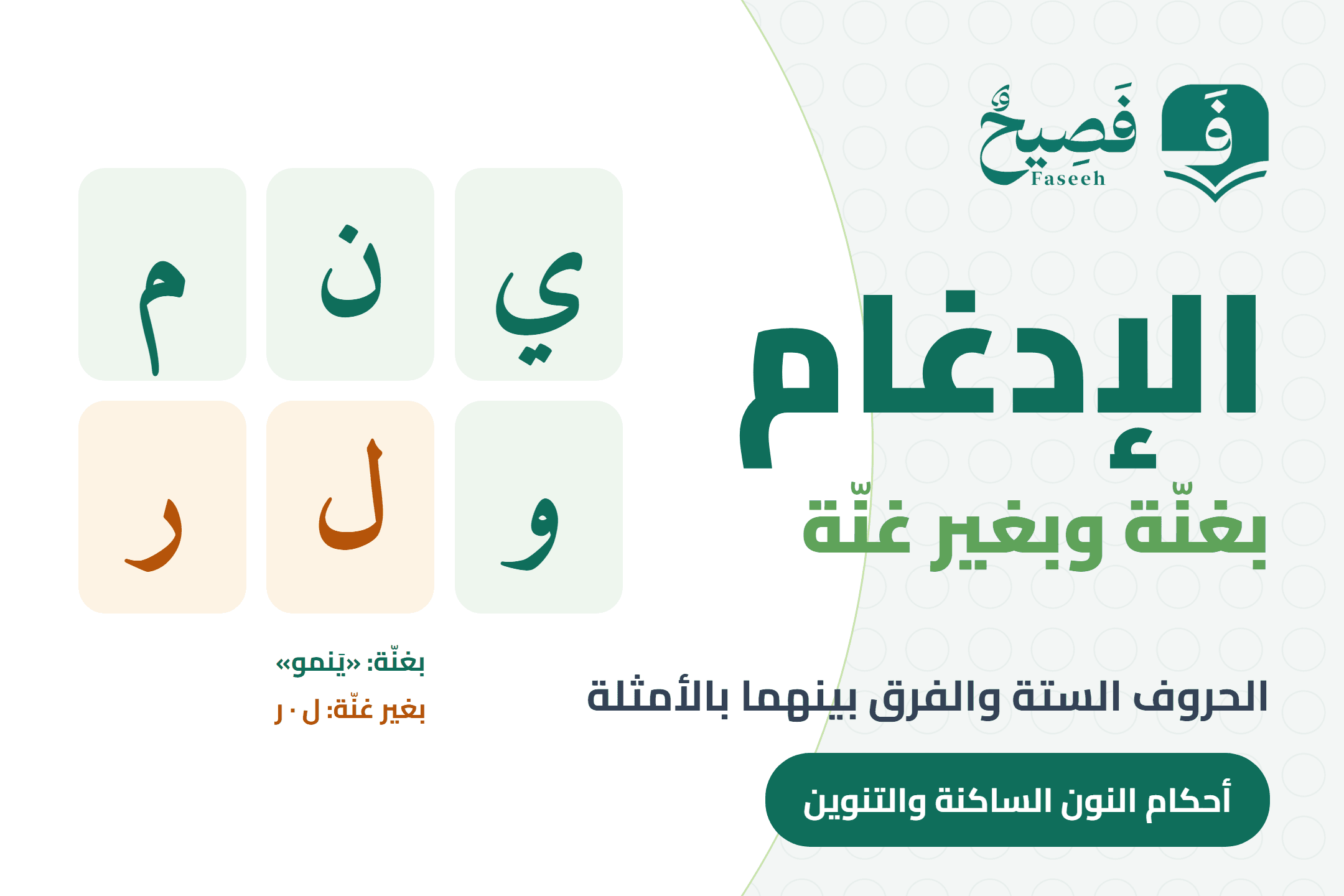
Idgham is divided into two types:
- Idgham with Ghunnah.
- Idgham without Ghunnah.
Idgham with Ghunnah
Idgham with Ghunnah occurs with four letters, collected in the word:
ينمو
They are:
- Yaa.
- Noon.
- Meem.
- Waaw.
When applying this rule, Noon Sakinah or Tanween is merged into the following letter while maintaining a nasal sound for two counts.
Examples of Idgham with Ghunnah
- ﴿مَنْ يَعْمَلْ﴾
- ﴿مِنْ نُورٍ﴾
- ﴿مِنْ مَاءٍ﴾
- ﴿مِنْ وَالٍ﴾
- ﴿وُجُوهٌ يَوْمَئِذٍ﴾
- ﴿خَيْرًا يَرَهُ﴾
When Does Idgham Not Occur?
Idgham does not occur when Noon Sakinah and the Idgham letter appear within the same word. In this case, the rule is known as Izhar Mutlaq, or absolute clarity.
Examples include:
- ﴿الدُّنْيَا﴾
- ﴿بُنْيَانٌ﴾
- ﴿صِنْوَانٌ﴾
- ﴿قِنْوَانٌ﴾
Idgham without Ghunnah
Idgham without Ghunnah occurs with only two letters:
- Laam.
- Raa.
In this rule, Noon Sakinah or Tanween is merged into the following letter without a nasal sound.
Examples of Idgham without Ghunnah
- ﴿مِنْ رَبِّهِمْ﴾
- ﴿مِنْ لَدُنْهُ﴾
- ﴿غَفُورٌ رَحِيمٌ﴾
- ﴿هُدًى لِلْمُتَّقِينَ﴾
Third: Iqlab
What Is Iqlab?
Linguistically, Iqlab means changing or transforming.
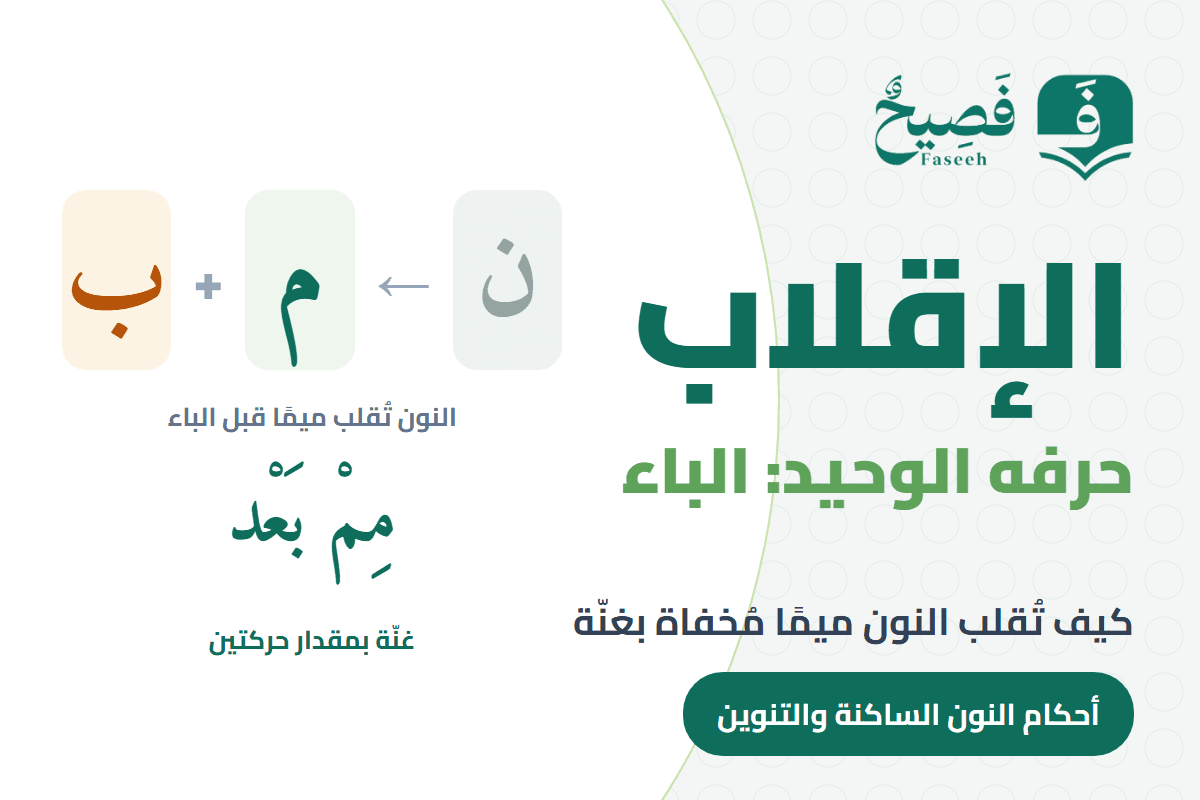
In Tajweed terminology, it means changing Noon Sakinah or Tanween into a concealed Meem when the letter Baa comes after it, while maintaining Ghunnah for two counts.
What Is the Letter of Iqlab?
Iqlab has only one letter:
- Baa.
How Is Iqlab Pronounced?
When Baa follows Noon Sakinah or Tanween, the Noon sound changes into a concealed Meem sound with Ghunnah for two counts.
The lips should not be pressed together too strongly, because this may turn the concealed Meem into a fully pronounced Meem.
Examples of Iqlab
- ﴿مِنْ بَعْدِ﴾
- ﴿أَنْبِئْهُمْ﴾
- ﴿يُنْبِتُ﴾
- ﴿سَمِيعٌ بَصِيرٌ﴾
- ﴿عَلِيمٌ بِذَاتِ الصُّدُورِ﴾
In some copies of the Qur’an, a small Meem is written above Noon Sakinah or Tanween to indicate the rule of Iqlab.
Fourth: Ikhfa Haqiqi
What Is Ikhfa?
Linguistically, Ikhfa means concealment.
In Tajweed terminology, it means pronouncing Noon Sakinah or Tanween in a way that is between Izhar and Idgham while maintaining Ghunnah for two counts.
What Are the Letters of Ikhfa?
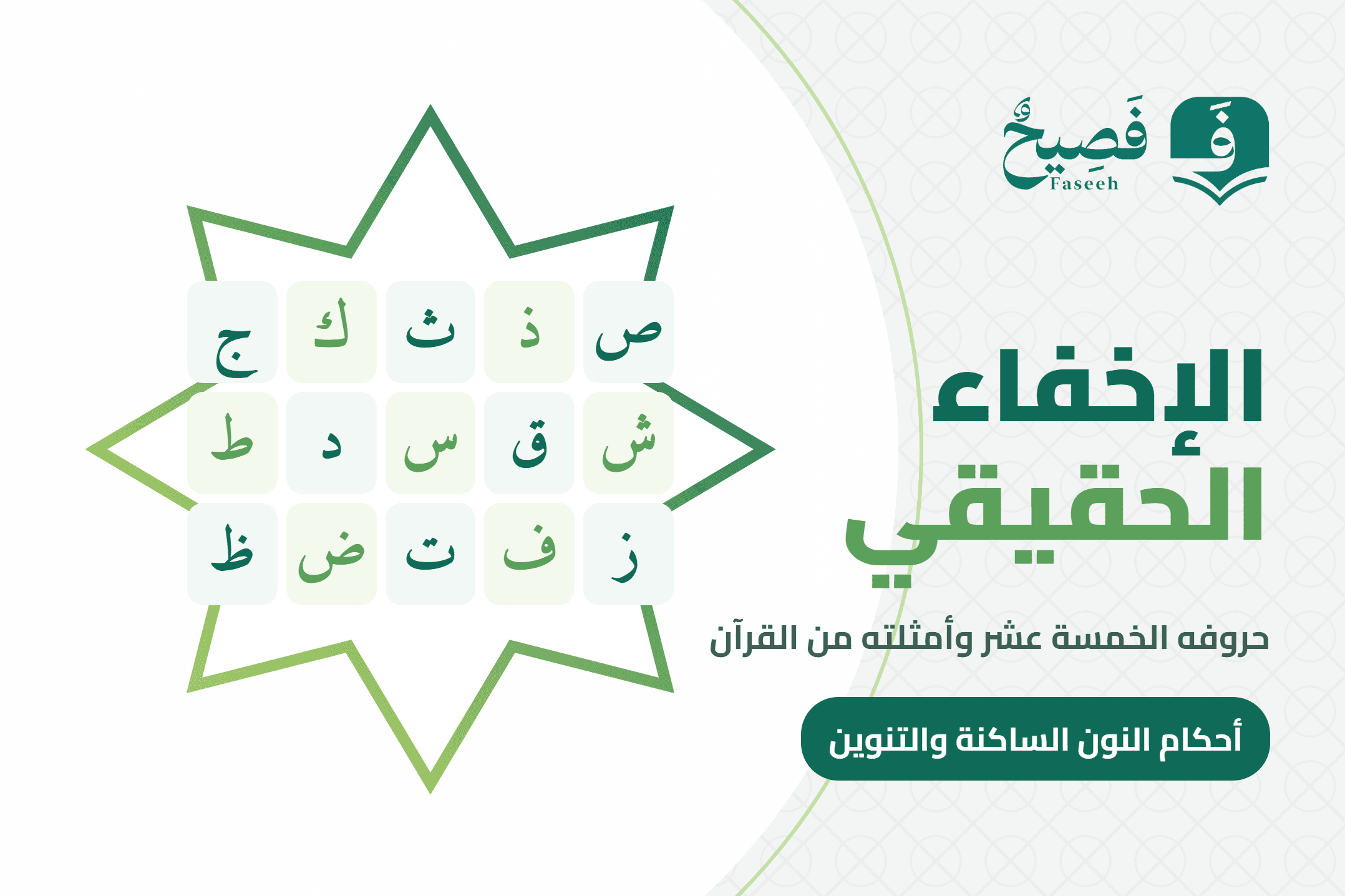
There are fifteen letters of Ikhfa:
- Saad.
- Dhal.
- Thaa.
- Kaaf.
- Jeem.
- Sheen.
- Qaaf.
- Seen.
- Daal.
- Taa.
- Zay.
- Faa.
- Taa.
- Daad.
- Zaa.
They are collected in the initial letters of the Arabic verse:
صف ذا ثنا كم جاد شخص قد سما دم طيبًا زد في تقى ضع ظالمًا
Examples of Ikhfa
- ﴿مِنْ صَلْصَالٍ﴾
- ﴿مِنْ ذَكَرٍ﴾
- ﴿مِنْ ثَمَرَاتٍ﴾
- ﴿مِنْ قَبْلُ﴾
- ﴿مِنْ شَرٍّ﴾
- ﴿مِنْ تَحْتِهَا﴾
- ﴿يَوْمَئِذٍ زُرْقًا﴾
- ﴿قَوْمًا ضَالِّينَ﴾
How Is Ikhfa Pronounced?
In Ikhfa, Noon Sakinah or Tanween is not pronounced fully clearly as in Izhar, nor is it completely merged into the following letter as in Idgham.
Instead, its sound is concealed while the Ghunnah remains.
The Ghunnah is affected by the following letter:
- It is pronounced with a heavier quality before emphatic letters such as Saad, Taa, Daad, Zaa, and Qaaf.
- It is pronounced with a lighter quality before non-emphatic letters such as Taa, Seen, and Faa.
A Simple Summary of the Four Rules
The four rules can be summarized as follows:
- Izhar: Occurs with the six throat letters. Noon Sakinah or Tanween is pronounced clearly.
- Idgham with Ghunnah: Occurs with Yaa, Noon, Meem, and Waaw, with a nasal sound for two counts.
- Idgham without Ghunnah: Occurs with Laam and Raa, without a nasal sound.
- Iqlab: Occurs before Baa. Noon Sakinah or Tanween changes into a concealed Meem.
- Ikhfa: Occurs with fifteen letters. The sound is pronounced between Izhar and Idgham with Ghunnah.
How Can You Distinguish Between the Rules?
You can identify the correct rule by looking at the letter that comes after Noon Sakinah or Tanween:
- If it is one of the six throat letters, the rule is Izhar.
- If it is one of the letters in the word “يرملون,” the rule is Idgham.
- If it is Baa, the rule is Iqlab.
- If it is one of the fifteen Ikhfa letters, the rule is Ikhfa.
One of the best ways to remember these rules is to memorize the letters and then practise them using different Qur’anic examples under the guidance of a qualified teacher.
Common Mistakes in Applying the Rules
Beginners may make several mistakes when applying the rules of Noon Sakinah and Tanween, including:
- Pronouncing Noon clearly in places of Ikhfa.
- Exaggerating the Ghunnah.
- Omitting Ghunnah in Idgham with Ghunnah.
- Adding Ghunnah to Idgham without Ghunnah.
- Pressing the lips together too strongly during Iqlab.
- Failing to distinguish between Izhar and Ikhfa.
- Applying Idgham within words that require Izhar Mutlaq.
- Depending on memorization without listening and practical application.
For this reason, Tajweed should be learned through direct practice and continuous correction, not through theoretical study alone.
How Can Beginners Learn These Rules Easily?
Beginners can learn the rules gradually through the following steps:
- Understand the difference between Noon Sakinah and Tanween.
- Memorize the names of the four rules.
- Memorize the letters associated with each rule.
- Listen to correctly recited Qur’anic examples.
- Repeat the examples aloud.
- Recite before a qualified teacher.
- Apply the rules during daily recitation.
- Review mistakes and correct them regularly.
Listening to skilled reciters and using an educational Mushaf can be helpful, but they do not replace the guidance of a teacher who can correct pronunciation and articulation.
The Relationship Between Articulation Points and These Rules
The rules of Noon Sakinah and Tanween cannot be applied correctly without understanding the articulation points and characteristics of Arabic letters, because each rule is connected to the following letter and the way it is pronounced.
For example, the letters of Izhar are called throat letters because they are articulated from the throat. Iqlab, however, requires an understanding of the articulation of Meem and Baa and the correct movement of the lips.
For this reason, Tajweed education usually begins with learning Arabic letters and their articulation points before moving on to detailed rules and practical application.
Learn Tajweed with Faseeh Educational Platform
Faseeh Educational Platform offers specialized programs that help students learn Tajweed and recite the Holy Qur’an correctly through a structured educational pathway suitable for different ages and learning levels.
Beginners can start with the Abjad Foundation Program, which helps them learn Arabic spelling, letter pronunciation, vowels, and elongation rules, enabling them to read the Qur’an correctly.
After mastering the basics, students can join Qur’an programs that include:
- Correct Qur’an recitation.
- Articulation points and letter characteristics.
- Rules of Noon Sakinah and Tanween.
- Practical training in Izhar, Idgham, Iqlab, and Ikhfa.
- Immediate correction of recitation mistakes.
- Qur’an memorization through a gradual plan.
- Continuous progress monitoring.
Lessons are delivered by qualified male and female teachers through live classes that allow students to listen, practise, and receive immediate feedback.
Why Choose Faseeh to Learn Tajweed?
Faseeh Educational Platform offers several advantages, including:
- Live and interactive learning.
- Qualified male and female Qur’an teachers.
- Programs suitable for children and adults.
- Individual and group classes.
- Flexible lesson schedules.
- Learning plans based on each student’s level.
- Regular progress reports.
- A free trial lesson before enrollment.
Frequently Asked Questions
What Are the Rules of Noon Sakinah and Tanween?
They are four main rules: Izhar, Idgham, Iqlab, and Ikhfa. The correct rule is determined by the letter that follows Noon Sakinah or Tanween.
How Many Letters of Izhar Are There?
There are six letters of Izhar: Hamzah, Haa, ‘Ayn, Haa, Ghayn, and Khaa.
What Are the Letters of Idgham?
The six letters of Idgham are Yaa, Raa, Meem, Laam, Waaw, and Noon. They are collected in the Arabic word “يرملون.”
What Is the Difference Between Idgham with Ghunnah and Idgham without Ghunnah?
Idgham with Ghunnah occurs with Yaa, Noon, Meem, and Waaw. Idgham without Ghunnah occurs with Laam and Raa.
What Is the Letter of Iqlab?
The only letter of Iqlab is Baa. When it follows Noon Sakinah or Tanween, the Noon sound changes into a concealed Meem with Ghunnah.
How Many Letters of Ikhfa Are There?
There are fifteen letters of Ikhfa. They are the remaining letters after excluding the letters of Izhar, Idgham, and Iqlab.
Can the Rules of Noon Sakinah and Tanween Be Learned Online?
Yes. They can be learned effectively through live online lessons, especially when supervised by a qualified teacher who provides explanation, practice, and continuous correction.
Begin Your Tajweed Learning Journey
Mastering the rules of Noon Sakinah and Tanween will help you recite the Holy Qur’an correctly and distinguish between Izhar, Idgham, Iqlab, and Ikhfa.
Begin your learning journey with Faseeh Educational Platform and benefit from live programs that combine clear explanations, practical application, and continuous support.
To learn more about the program that suits your level or to book your free trial lesson, contact the Faseeh team via WhatsApp. The specialists will help you choose the most suitable learning pathway for you or your children.
İlgili gönderiler

Characteristics of the letters in Tajweed: A comprehensive guide to mastering the pronunciation of the letters of the Quran.
18 July 2026

Learn the ten readings remotely under the supervision of specialists in Quranic sciences.
18 July 2026

The articulation points of letters in Tajweed: the secret of pronunciation and the balance of expression.
18 July 2026