The articulation points of letters in Tajweed: the secret of pronunciation and the balance of expression.
The articulation points of letters in Tajweed are among the most important foundations for the correct pronunciation of the Arabic language, especially when reciting the Holy Quran. Mastering the articulation points is not merely a vocal skill; rather, it is a precise system that regulates pronunciation and preserves meanings from distortion.
At Faseeh Platform, we believe that mastering pronunciation begins with properly understanding articulation points. Therefore, we present this science in a simplified and practical way suitable for all learning levels.
In this guide, you will learn about the importance of articulation points, their categories, and how to learn them in an easy and effective way.
What is the importance of articulation points in Tajweed for correct pronunciation?
Arabic eloquence begins with mastering the articulation points in Tajweed. Whoever masters the articulation point can:
- Pronounce letters correctly
- Excel in Quranic recitation
- Avoid mistakes that may affect meanings
Articulation points are not just theoretical information; they are the foundation that determines the clarity and accuracy of words.
What is the articulation point of a letter in Tajweed?
The articulation point of a letter is defined as:
The place from which the sound of the letter emerges when pronounced, whether from the mouth or the throat.
Each letter in the Arabic language has a specific articulation point that distinguishes it, providing:
- Each letter with an independent sound characteristic
- Each word with accuracy in meaning
Tajweed scholars have given great attention to this science because it is the foundation of reading the Holy Quran as it was revealed. It is also connected to understanding Characteristics of Letters in Tajweed, which explains the qualities of each letter and its unique sound features.
What are the categories of articulation points in Tajweed?
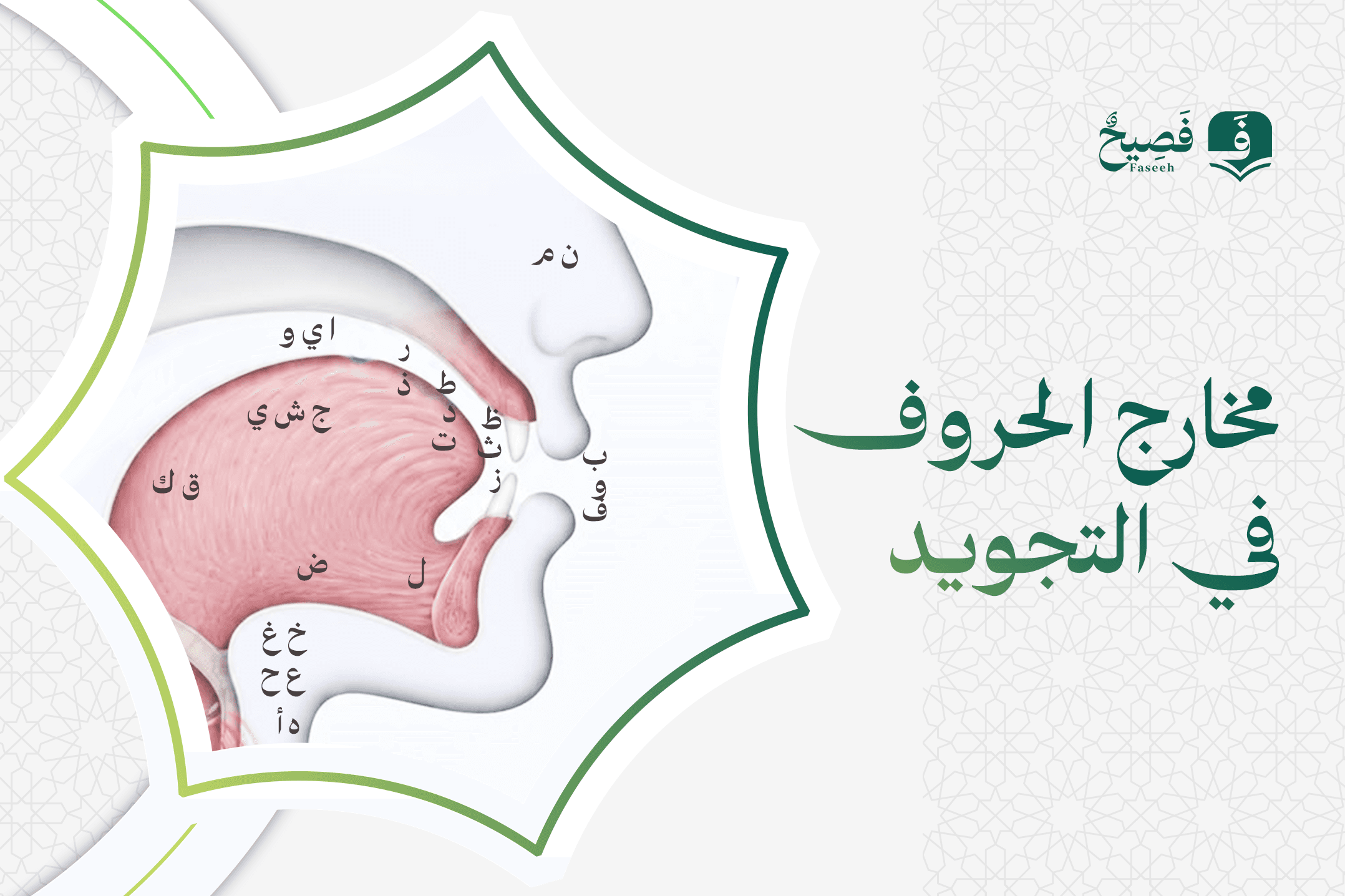
The articulation points in Tajweed are divided into five main categories:
- The Oral Cavity (Al-Jawf)
It is the internal space of the mouth and throat, from which the following emerge:
Long vowels (Alif, Waw, Ya)
- The Throat (Al-Halq)
It is divided into:
The deepest part of the throat: (ء، هـ)
The middle part of the throat: (ع، ح)
The nearest part of the throat: (غ، خ)
- The Tongue
It is the largest articulation point, and most Arabic letters emerge from it, such as:
Ta, Ra, Seen, Dad
- The Lips
The following letters emerge from them:
Ba, Meem, Waw
- The Nasal Cavity (Al-Khaishoom)
It is the articulation point of Ghunnah and is specific to:
The doubled Noon and Meem
The detailed articulation points reach seventeen points with remarkable precision.
How do practical examples help in understanding articulation points?
To understand articulation points practically:
- From the deepest part of the throat: Hamzah and Haa
- From the middle of the throat: Ain and Haa
- From the nearest part of the throat: Ghayn and Khaa
- From the oral cavity: Long vowels
- From the tongue: According to its position
- From the lips: Baa and Meem
- From the nasal cavity: The sound of Ghunnah
Practical application makes learning faster and more effective.
Why is practical training essential for mastering articulation points?
Mastering articulation points in Tajweed cannot be achieved through reading alone. It requires:
- Listening training
- Careful observation
- Learning from a specialized teacher
Some learners may confuse:
- Haa and Ain
- Sad and Seen
This confusion may change meanings. Therefore, practical training is the foundation of mastery. This skill can be developed through Teaching Tajweed for Beginners using a gradual approach that helps learners understand the rules and apply them correctly.
How do articulation points reflect the precision of the Arabic language?
When observing the system of articulation points, we recognize:
- The precision of the Arabic language
- Its unique phonetic organization
- Its ability to preserve meanings
The Arabic language does not rely on randomness; rather, it is based on a precise phonetic system that distinguishes every letter accurately. This makes learning correct pronunciation an essential step toward understanding the beauty of the language and mastering its use.
How can you learn articulation points in Tajweed easily?
You can learn articulation points in Tajweed effectively through:
- Starting with basic letters
- Listening to correct Quranic recitations
- Daily practice
- Learning with a specialized teacher
Understanding fundamentals such as the Abjad Foundation Course helps build a strong foundation for correct pronunciation from the beginning. It also enhances your understanding of the relationship between letters and meanings within the Arabic language.
At Fasih Platform, we provide a comprehensive educational experience through courses such as the "Abjad Foundation Course", which helps you:
- Master correct pronunciation
- Improve recitation
- Apply Tajweed rules practically
What is the relationship between articulation points and Quran memorization?
Articulation points are essential foundations for anyone who wants to memorize the Holy Quran and master its recitation, because correct pronunciation helps in:
- Reading Quranic verses correctly
- Avoiding mistakes that may change meanings
- Strengthening memorization and improving recitation quality
Therefore, Fasih Platform provides a specialized path such as Quran Memorization | Quran and Tajweed Path, which combines memorization and Tajweed through an organized educational approach.
Conclusion
The articulation points of letters in Tajweed are not just theoretical rules; they are the foundation of beautiful recitation and correct pronunciation. Every letter pronounced from its correct articulation point reflects the precision of the Arabic language and preserves meaning from errors.
Start your journey today with Fasih Platform and learn correct pronunciation step by step to achieve a refined recitation filled with clarity and mastery.
Discover the suitable learning path through Fasih Packages and Prices.
Contact through this link.
Frequently Asked Questions:
1. What is the importance of articulation points in Tajweed for improving recitation?
Articulation points in Tajweed are essential for correct recitation, as they help pronounce Arabic letters correctly, prevent mistakes that may affect meanings, and enhance the clarity and beauty of Quranic performance.
2. How many articulation points are there in Tajweed?
The number of articulation points in Tajweed is seventeen detailed points, distributed among five main areas: the oral cavity, throat, tongue, lips, and nasal cavity. They are the foundation for learning proper Tajweed.
3. How can I learn articulation points in Tajweed correctly?
You can learn articulation points in Tajweed through listening to correct recitations, continuous practical training, and learning from a specialized teacher who helps correct pronunciation and apply Tajweed rules properly.
4. What is the difference between articulation points and characteristics of letters in Tajweed?
Articulation points are the places where the sound of a letter emerges when pronounced, while characteristics of letters are the phonetic qualities that distinguish each letter from others, such as strength, softness, and other pronunciation features. Both are necessary for mastering Tajweed.
5. Does learning articulation points help improve Arabic pronunciation?
Yes, mastering articulation points improves not only Quranic recitation but also correct Arabic pronunciation, strengthens eloquence, and develops reading and speaking skills in the Arabic language.