How to Start Memorizing the Quran: A Beginner’s Plan
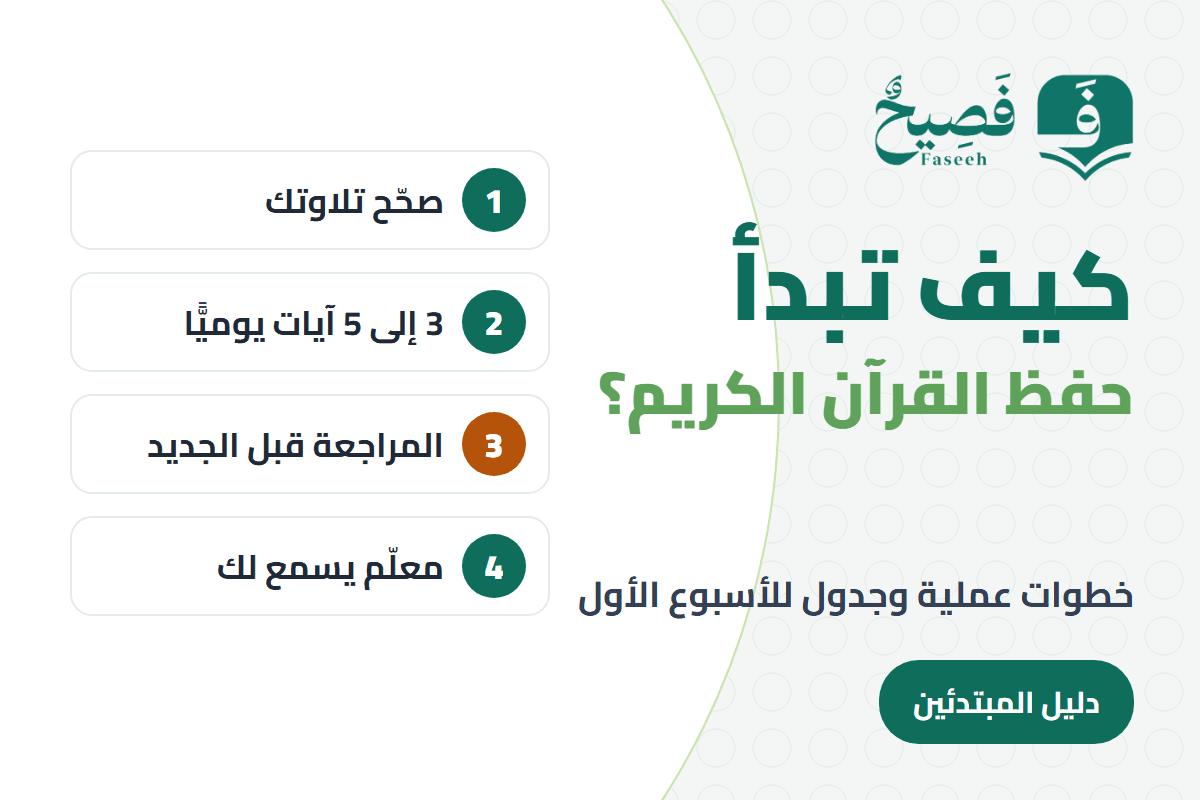
How do you start memorizing the Quran? The short answer: start with a small, fixed amount every day, after correcting your recitation, and always revise before you memorize anything new. Five verses memorized and revised daily are better than a full page that stops after a week.
Most people who stop memorizing do not stop because of a weak memory. They stop because they started with great enthusiasm and a plan heavier than their day. This guide gives you a practical path from zero: what to do before your first verse, how to choose your daily amount and time, how to memorize a page step by step, a ready plan for your first week, and how to protect what you memorize from forgetting.
﴿وَلَقَدۡ يَسَّرۡنَا ٱلۡقُرۡءَانَ لِلذِّكۡرِ فَهَلۡ مِن مُّدَّكِرٖ﴾ "And We have certainly made the Quran easy to remember, so is there anyone who will be mindful?" [Al-Qamar: 17]
Getting Started at a Glance
| Before memorizing | Correct your recitation and pick one Mushaf you never change |
| Where to start | Juz Amma, or short surahs you already partly know |
| Daily amount | 3 to 5 verses for a beginner, more after a month if it sticks |
| Daily time | 20 to 30 minutes, at a fixed time |
| Golden rule | Revision first, then new memorization |
| Fastest way to stay consistent | A teacher who listens and corrects you, even twice a week |
Before Your First Verse: Three Steps That Save You Time
1. Correct your recitation first
Memorization locks in what you read exactly as it is, mistakes included. If you memorize a word with the wrong pronunciation, fixing it later is harder than memorizing it the first time. So recite the passage to a teacher, or listen to a skilled reciter, before you start repeating it.
This does not mean waiting until you master every Tajweed rule. At the start it is enough to pronounce the letters from their correct points of articulation and know basic rules such as the rules of Noon Sakinah and Tanween. You can learn the rest along the way.
2. Choose one Mushaf and never change it
Your visual memory works for you without you noticing: you remember where a verse sits on the page, and where each page starts and ends. Change the Mushaf and that picture is lost. Choose the Madinah Mushaf (604 pages, each page starting and ending with a complete verse) and memorize from it alone.
3. Renew your intention and set a short goal
Do not say "I will memorize the whole Quran" on day one. Say "I will memorize Surah An-Naba this month." A near goal can be measured, and every goal you reach gives you the drive for the next one.
Where Should You Start?
There are three common starting points. The first suits most people:
| Starting point | Best for | Why |
|---|---|---|
| Juz Amma (from An-Nas back to An-Naba) | Most beginners and children | Short surahs you finish quickly, many already familiar |
| Surah Al-Baqarah from the beginning | Fluent readers who want the Mushaf order | Follows the Mushaf, but long for a beginner |
| Surahs you love and repeat (Al-Mulk, Al-Kahf) | Anyone who needs strong motivation early on | A personal connection makes memorizing easier |
More important than where you start is choosing one order and sticking to it, instead of jumping between surahs every week.
How Much Should You Memorize Per Day?
Start with less than you think you can handle. The question is not "how much can I memorize today?" but "how much can I memorize every day for a year?"
| Your level | Suggested daily amount | Approximate time |
|---|---|---|
| Complete beginner | 3 verses | 15 to 20 minutes |
| Fluent reader | 5 verses or half a page | 20 to 30 minutes |
| After two consistent months | One full page | 30 to 45 minutes |
Your amount grows on its own over time: your mind gets used to memorizing, and words repeat across the Quran, so new passages become easier.
How to Memorize a Page, Step by Step
This method works for a few verses or a full page:
- Listen: play the passage by a skilled reciter 3 times while looking at the Mushaf.
- Read while looking: read the passage from the Mushaf 10 times, slowly and aloud.
- Split it: take the first verse alone and repeat it without looking until you say it 3 times in a row without a mistake.
- Link: move to the second verse the same way, then recite both together. Each new verse is linked to the ones before it.
- Recite the whole passage: without looking, 3 times in a row with no mistakes.
- Link today's end to tomorrow's start: read the first verse of tomorrow's passage twice while looking. This prevents gaps between passages when you recite.
Tip: recite aloud, even quietly. When you hear your voice and move your tongue, your ears, eyes and tongue work together, and the memorization settles faster than reading with your eyes alone.
Your First-Week Plan
A simple plan for a beginner starting from the end of Juz Amma, at 3 to 5 verses a day:
| Day | New memorization | Revision before new |
|---|---|---|
| Day 1 | An-Nas and Al-Falaq | None |
| Day 2 | Al-Ikhlas and Al-Masad | An-Nas and Al-Falaq |
| Day 3 | An-Nasr and Al-Kafirun | An-Nas to Al-Masad |
| Day 4 | Al-Kawthar and Al-Ma'un | An-Nas to Al-Kafirun |
| Day 5 | Quraysh and Al-Fil | The previous eight surahs |
| Day 6 | Revision only | Everything from this week |
| Day 7 | Recite to a teacher or relative | Everything from this week |
The two revision days are not a break from memorizing. They are what makes this week's memorization stay with you.
Revision: The Secret of Memorization That Lasts
New memorization fades quickly without revision. The Prophet ﷺ said: "Keep refreshing your knowledge of this Quran, for by the One in whose hand is the soul of Muhammad, it escapes more readily than camels from their hobbles." [Muslim]
Split your daily revision into two parts:
- Recent revision: everything from the last 7 days, read every day before new memorization.
- Older revision: everything before that, divided across the days of the week so you go through all of it at least once a week.
The best time to revise is in prayer: recite what you memorized recently in your Sunnah, voluntary and night prayers, and you revise it without setting aside extra time.
Common Mistakes That Stop Beginners
| Mistake | Why it hurts | Instead |
|---|---|---|
| Starting with a large amount | You get tired within days and stop | Start with 3 verses and increase after a month |
| Memorizing without revising | You forget last week and feel you are not progressing | Always revise before new memorization |
| Changing your Mushaf | The picture of the page in your memory is lost | One Mushaf from the start |
| Memorizing without correcting recitation | The mistake becomes fixed and hard to correct | Recite to a teacher or listen to a skilled reciter first |
| Waiting for "the right time" | It never comes | A fixed daily time, even 15 minutes |
| Memorizing completely alone | Nobody catches your mistakes or encourages you | A teacher or partner who listens to you |
Memorize Alone or With a Teacher?
You can start alone, and many people have. But a teacher saves you three things: they correct your pronunciation before a mistake settles, they listen to your memorization and catch what you think is solid but is not, and they give you fixed appointments that make it easier to keep going.
The Prophet ﷺ said: "The best of you are those who learn the Quran and teach it." [Al-Bukhari] The Quran is learned by receiving it from a teacher. That is how the Companions took it from the Prophet ﷺ, and how it has been passed on generation after generation.
If you are looking for this for your child, read the benefits of memorizing the Quran for children, or see Faseeh's Quran memorization program for kids.
Frequently Asked Questions
Can I memorize the Quran as an adult?
Yes. An adult may memorize more slowly than a child, but is better at understanding, organizing and committing. Understanding the meaning of a verse is one of the strongest aids to memorizing it. Start with a smaller amount and focus on consistency, not speed.
What should I do if I stop for a few days?
Do not start over, and do not try to make up for the missed days all at once. Go back to revision first until your earlier memorization returns, then continue with your usual daily amount.
Should I memorize by listening or by reading the Mushaf?
Combine both: listen to get the pronunciation right, look to fix the picture of the page, then recite without looking to confirm your memorization.
What is the best time to memorize?
The time you can keep every day. Many people find the time after Fajr the clearest, but a fixed evening time beats an ideal time you cannot keep.
Do I need to understand the tafsir before memorizing?
It is not required, but it helps a lot. Read the meaning of the verses in a short tafsir before memorizing them: words you understand are memorized faster and forgotten more slowly.
Start Today
Do not wait for a perfect plan. Open the Mushaf now at Surah An-Nas, listen to it, read it ten times, and memorize it. That is the start. Tomorrow, revise it, then memorize Al-Falaq.
If you want someone to listen to you and correct your recitation from day one, book your free session at Faseeh with a qualified teacher, at a time that suits you.